Mennonite blood quarantine
The Dog StarsThe Mennonite blood quarantine is an informal barrier formed by warnings about illness and the fear they inspire. It keeps outsiders away from a vulnerable community after the flu, helping protect its members from attack even as the disease continues to take lives. When Cima later explains the limits of transmission to Hig, the warning’s protective effect and its cost become visible at once.
The illness behind the warning
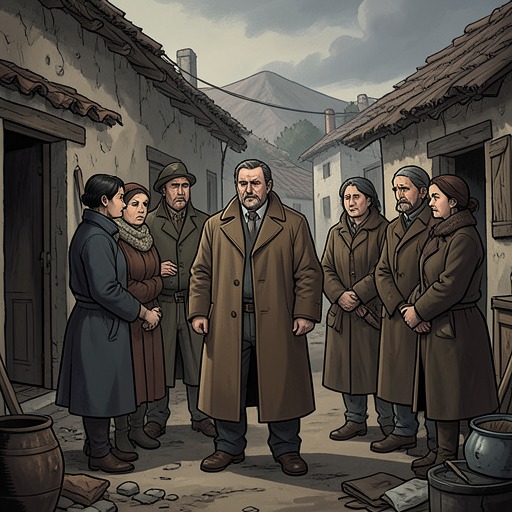
Hig describes roughly thirty people in the Mennonite community living south of his perimeter, about ten miles away. Their blood disease emerged after the flu, and he compares it tentatively to AIDS while acknowledging uncertainty about how contagious it is. Children were born with the illness; it left them sick and weak, and some members of the community died each year.
The wider history of the pandemic remains uncertain, too. Cima recounts reports and rumors about the Africanized bird flu, including speculation about its origin, but the account does not establish a confirmed source. That uncertainty matters to the quarantine: the community is living with serious consequences of disease without a settled public understanding of either its origins or its risks.
How the quarantine works
Signs at the edges of the community’s fields announce THE BLOOD. The warning turns illness into a visible boundary: outsiders encounter a frightening label before they encounter the people behind it. Hig recognizes that the fear the signs evoke has kept attackers away and preserved the community, although the disease itself continues to kill its members.
The protection is therefore real but precarious. It depends on people staying away because they believe contact is dangerous, not on a cure or a reliable system of care. The same alarm that helps deter violence also reinforces the community’s isolation.
Cima’s explanation and Hig’s response
When Cima treats the community’s members in the old farmhouse, she wears latex gloves, examines them one by one, tends wounds, and offers care to people facing very different needs, including a pregnant young woman and a grieving older man. She tells Hig that the belief that ordinary proximity is dangerous is mistaken: transmission involves blood or other bodily fluids, rather than simply being near someone. Her explanation gives Hig grounds to cross into the community and mingle with its people.
This clarification changes the quarantine from an unquestioned rule into a boundary that can be reconsidered. Cima’s medical knowledge does not erase the illness or the history of fear, but it makes direct care possible where distance had seemed necessary. Her work also distinguishes practical precautions from the broader terror carried by THE BLOOD warning.
Protection and consequence
The quarantine holds two truths together: the warning’s power to deter attackers has helped keep the community alive, while fear and misunderstanding have also marked its members as people to avoid. The signs offer a kind of protection without resolving the underlying crisis. Cima’s intervention does not make the disease harmless; it gives Hig a more accurate account of risk and allows assistance to cross the boundary.
The illness itself remains incompletely understood. Cima refers to reports suggesting that the onset of the autoimmune disease may have been accelerated by the body’s impaired ability to produce vitamin D, but presents this as a proposed mechanism, not a proven explanation. The account thus leaves the quarantine suspended between medical uncertainty and practical necessity: a warning born of danger, sustained by fear, and partly corrected by care.